Saturday, 22 February 2014

Ghosts of Indonesia

In Indonesia, most people believe in ghosts. You may be thinking 'hehe, that's cute, but ghosts aren't real', and admittedly, I thought the same thing upon first hearing this. But after learning more about the ghosts and going on a ghost-hunting expedition with my neighborhood friends, I started to realize that I really don't know whether or not ghosts are real. Who am I to insist that they don't exist? I have less proof that they don't exist than they have of the contrary. I'll fill you in on my adventure and some ghost profiles and let you decide for yourself.

The time approaches ten o'clock pm as we leave the prayer ceremony outside my neighbor's house. As I depart, I get word from one of my friends informs me that a group of thrill-seekers are going on a ghost-hunt on the grounds of my high school at midnight. 

I return, spirited (pun intended) and armed with a camera at the designated time. The instructions are clear: 

1. Take pictures of dark, spooky places where you believe a ghost might be present.
2. Do not look at the pictures. They will be investigated after the ghost-hunt is completed.

We spend the next hour creeping around dark alleys, abandoned buildings, and my school grounds, which are extremely spooky at night. Everyone in the group is very intent on finding ghosts, and their attitudes make the experience very genuine and creepy. As we walk around, they tell me stories of past ghost-hunts. 

"Last year, I spotted a 'kuntilanak' (a dead mother with dark hair over her face in a white gown) right here. I ran away immediately."

There is no element of fraudulence in the hunt. No one pretends to see a ghost or pretends to be scared. This is no joke, for them it is serious business. And soon it became serious business for myself as well. As  the night went on, I felt less like a tourist enjoying their silly ghost hunt and more engulfed in the possibility that there were ghosts all around us.  

At one point, I hid in a dark bathroom behind the door and wait for my friends to come looking for me. I pop out and scare one of them. His reaction indicates that doing such things is not cool. I am shamed for m immaturity.

After sufficient pictures are obtained, we head back to a friend's house to analyze the photos. As we look at the pictures, I am informed that the bright spots in the pictures, which may or may not be due to the reflection of the flash off objects in the surroundings, are ghost energies. We shuffle through the pictures and I continually try to point out ghost figures. My suspicions are consistently denied. Silly foreigner, that's no ghost. 

After going through all of my photos, no ghosts were seen. Proving two things: 
1. I am a horrible amateur ghost photographer.
2. They do not fabricate ghost sightings.

After an amazing ghost-hunting experience, I decided to find out more about Indonesian ghosts, or 'hantu-hantu'. Here is some information that my students shared with me:

Hantu Indonesia

Pocong- a mummy ghosts with a scary face that hops instead of walking.


Kuntilanak- a dead woman with long black hair over her face wearing a white gown who may be pregnant.


Suster Ngesot- A hospital nurse with a broken foot who cannot walk properly, so she crawls. Lives in Jakarta hospital.


Pastur Kepala Buntung- ghost who carries his own head, has a ghost dog with a read eye. Stays on Jakarta graveyards. One must run around the graveyard 7 times to see the ghost.


Tuyul- a small, bald, dead boy.


Noni Belanda- beautiful Dutch girl with long hair and a long, white dress.


Pukang- flying ghost with one leg and a face full of blood who marches through the air like a military person.

I couldn't find a picture of this one.

It should also be noted that as a result of their beliefs, Indonesians LOVE scary movies. My first week here, I was invited to see The Conjuring 2 fives times by my students. I only actually saw it twice. Good movie. 

Monday, 27 January 2014

Indonesian Names

Here is a list of as many Indonesian names as I can remember right now. Most of these are nicknames because that is how I know most people. Their full names are usually longer and harder to remember, so I stick with nicknames.

Ibu Tismay and I at end-of-semester
 teachers' party. I was having fun I swear.
Female:

  • Yuyun
  • Nuretta
  • Nellie
  • Cantika
  • Astria
  • Rafira
  • Ayu
  • Refa
  • Lila 
  • Ochie
  • Fiori
  • Sinta
  • Oudie
  • Indah (means 'beautiful')
  • Buanna 
  • Nurul
  • Ganesa
  • Emil
  • Yulia
  • Ade
  • Maya
  • Tismay
  • Eti
  • Yana

The nature of Indonesian culture is such that I am a lot closer to the males in my community, and thus remember a lot more male names. A lot of social and business interactions are segregated by gender and co-ed interactions usually occur in large groups. For instance I rarely ate dinner with Ibu Yuyun, my house mom, before her cousin, Pak Fadil, moved in with us. Now, I eat dinner every night with Pak Fadil, because he is a male and it is socially acceptable for us to eat alone together.

Bagus and I at our coach's wedding.
Male:

  • Adit
  • Made
  • Ryan
  • Tongku
  • Aristha
  • Rifqi (one of the most common names)
  • Riski
  • Zico
  • Arif
  • Zen
  • Iklas
  • Ali
  • Mohammad
  • Bagus (means 'good')
  • Ondet
  • Dedi
  • Budiono
  • Riduan
  • Rahmad
  • Humzalah
  • Bayu
  • Nafaldi
  • Dandi
  • Dani
  • Danu
  • Fadil
  • Moyo
  • Andre
  • Minus
  • Jeffrey
  • Aji
  • Rico
  • Ichan
  • Enal
  • Angga
  • Pagas
  • Ardie
  • Doyok
  • Harry
  • Coco
  • Randi

Interesting note: When Indonesians refer to someone shorthand, or by nickname, most of the time the derive the shortened name from the end of the word. In America, we almost exclusively use the beginning of the name. For example, to get Bagus's attention on the basketball court, you would yell "Gus!" (like goose). Pagas becomes 'gas' (long a), Rifqi becomes 'qi', Nafaldi becomes 'di', and so on.

Saturday, 25 January 2014

Thoughts on Bahasa Indonesia

Bahasa Indonesia is the official language of Indonesia. The language is adapted from Malay and was established as the country's official language with the declaration of Indonesian independence in 1945. There are more than 700 languages living languages spoken throughout Indonesia, most of them variations of Bahasa Indonesia. All Indonesian people speak Bahasa Indonesia and use it in formal social settings, but most Indonesians speak their local dialect as their 'first language'. Of these dialects, Javanese is the most widely spoken. As of 2000, 84.3 million Indonesians spoke Javanese throughout Northern Banten, West Java, YogyakartaCentral Java, and East Java.

3.9 million people speak Bahasa Palembang, the dialect which is spoken in my city of Palembang. I have been learning some Bahasa Palembang throughout my stay. It's distinction from Bahasa Indonesia is simple in many ways. While there are many words unique to Bahasa Palembang, oftentimes a word ending with 'a' is replaced by an 'o' to create the Palembang word. For example, 'lupa' meaning to forget is spoken as 'lupo' in Bahasa Palembang.

Bahasa Indonesia, like much of Indonesian culture, is greatly influenced by Islam. There are many commonly used words in Bahasa Indonesia that are directly adapted from Arabic. Here are a few examples:

'Selamat pagi' (good/safe morning): Selamat is adapted from the Arabic word 'salam', an Arabic greeting which denotes safety/well-being

'Apa kabar?' (literally 'what's the news', like 'how are you?'): Kabar is the Arabic word for 'news'.

As a whole, Bahasa Indonesia is a very simple language. Grammar is straightforward and there are no verb conjugations. Ideas or thoughts which are expressed in many ways in English are oftentimes expressed with one redundant phrase or word in Bahasa Indonesia. While the pompous Frenchmen of L'Academie Francaise would condescend the language for it's lack of intricacy, I believe that the language's simplicity is interesting and reflective of Indonesian culture.


Sporting some traditional clothes at my basketball
coach's wedding. The bride and groom are on my sides.
As a result of the language's simplicity, communication in Indonesia relies heavily on body language and context. I have found that the Indonesian people have an uncanny ability to read facial expressions and physical cues in a way that I am unable to comprehend. If I don't sleep enough and look tired at school, my state of being will inevitably be noticed and mentioned by my coworkers and students. The slightest, often subconscious expression of sadness or boredom is always picked up by my Indonesian friends. I will never forget how my students commented on my elated state of being after we went shopping and I finally found a pair of soccer shoes that fit my long feet. While I did not say or do anything to purposefully express my happiness, my students exclaimed "Mr. Matthew is happy now" as they read my subtle body language that I myself did not even notice I was exhibiting. 

The simplicity of the language has, surprisingly, made it rather hard for me to understand conversations between second and third parties. While I am able to understand many words that are said in the exchange, the actual tone or meaning of the conversation is very hard to discern. The reason, I believe, is that the context of the conversation is far more important than the vocabulary words which I can understand. The significance of the words that I do understand lies in the context, which is more based on the tone and other clues beyond the mere vocabulary.

Here are some fun things that I've learned about Bahasa Indonesia:

  • The is no word for 'him' or 'her', only the word 'dia', which is unisex. Often, people are referred to as 'ini', which means 'this'. This fact may give some insight into how Indonesians perceive the importance of gender. Or maybe not. This also makes it hard for Indonesians to learn the difference between the words 'him' and 'her', and 'mister' and 'miss'.
  • There is only one response to the question 'Apa kabar?' or 'how are you?'. The response is always 'beik', which means 'good' or 'fine'. This shows that this question, much like 'how are you?' is a merely a greeting and not an inquiry into one's current state of being.
  • The expression for 'no problem' is 'tidak apa apa' which literally translates to 'not what what'.
  • A common question to ask how one is doing is 'sudah makan nasi?' which means 'have you eaten rice?'.
  • The word for 'water' in Bahasa Indonesia is 'air'. Isn't that ironic?
  • To express that you do not want something, you are supposed to say "Terima kasih" which means 'thank you'. This has made denying or accepting peoples' offers rather confusing and awkward at times. When I do want something, I try to nod my head and say 'terima kasih', but sometimes the point doesn't get across, so I say, "Saya mau, terima kasih" which means, 'I want, thank you!".
Here's a short sample of some Bahasa Indonesia from Youtube:
https://www.youtube.com/watch?v=eti6SZXgRXQ


Wednesday, 27 November 2013

Bola Basket Bonanza

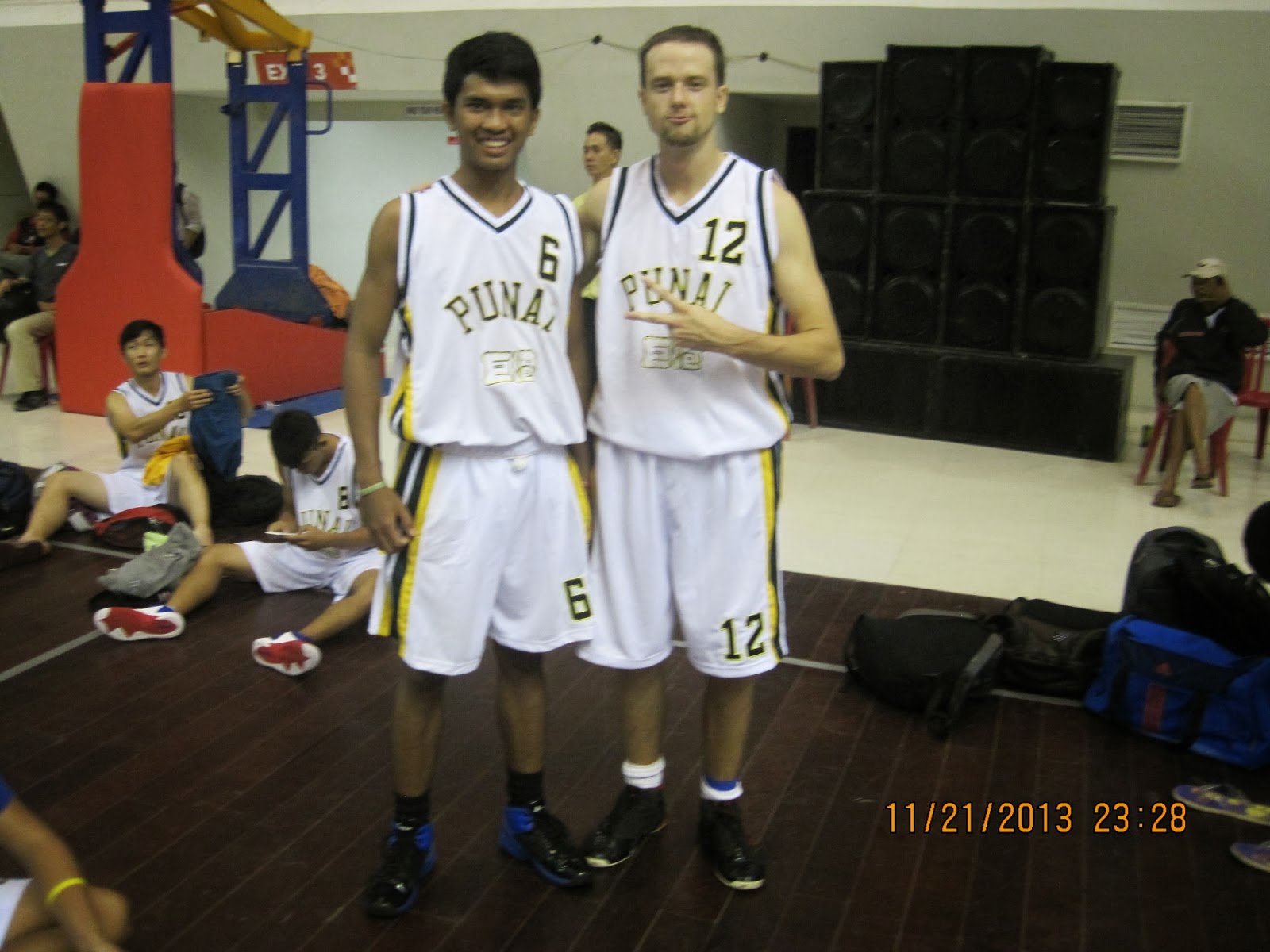
After I started helping out with my high school's basketball team, I met a group of kids my age who also help out with the team. Bagus, my dearest of these homies, invited me to come play with his club basketball team called Punai. After my first practice, Coach Ardi was fond enough of my lank and my skills to invite me to be permanent member of the squad. After two practices with the team, we had a tournament at the Palembang Sports and Convention Center. The arena was originally constructed for the 2011 South East Asia games to which Palembang played host. My expectations of the magnitude of the arena or the legitimacy of the tournament were greatly exceeded upon my arrival at the stadium.


Some high school teams played before us and the fans came in great numbers, drums and endless chants included. Very reminiscent of European soccer games.


I knew we had a solid squad coming into the tourney. I rotated on center with two other tall humans. I have come to expect a reasonable level of attention anywhere that I go in Palembang, as it is not a tourist city and white guys are few and far between. In this case, the attention compounded with my pre-ballin' nerves, so my performance on the court was less than great. My teammates could sense my anxiety and continued to tell me to 'woles'- Indonesian for 'chill out'. Some of my students and friends came to watch the games, and it helped to have some familiar, friendly faces in the crowd. What did not help was the emcee, who felt it necessary to scream "AIRBALL!!" into the microphone after my attempted three-point shot. At least she knew some English...


Bagus and I post-game. Bagus is Indonesian
for 'good' so you can imagine the fun
I have with his name.
Minus and I. He is the star of the best
high school team in town- Xavierius 3,
and also the star of our team.
Girls game prior to our third match.
The whole gang. 'Keep Smile!'
We played four games, winning the first two by landslides and losing the second two in nail-biters against som more formidable opponents. I scored a whomping two points in four games, but I was actually pretty happy that I didn't play very well. I already felt kind of bogus walking on to the team and stealing playing time away from players who had been with the team all year. I attribute a lot of that to the fact that I am an exotic foreigner, and maybe a little bit to my ferocious defensive playing style and god-given lank that was intended for the basketball court.  

Head Coach Ardi and Me.
Assistant Coach and Me.
After the last game, which ended at midnight on Saturday night, we headed to the nearest warung for a post-game munch. I feel so blessed to have found a team to belong to. It made me feel so comfortable, stretching in the locker room with my new team, warming up with serious faces and occasional jokes. I loved feeling nervous before going out onto the court. It is a feeling that I have experienced throughout my life, and it transcends time or place. There is a comradery that one builds with his teammates that cannot be recreated in any other social setting. Battling on the court for each other, supporting each other through thick and thin, sweating and laughing and celebrating together. For as long as I can remember, I have always had a team- a group of friends who you care for without question or explanation, but simply because they are your teammates. I have this team now in Palembang and it certainly helps to make my new home to feel a lot less foreign.

Thursday, 14 November 2013

On Feeling Loved

     It’s easy to feel loved at home. The people you spend your time with have shown you a thousand different ways that they love you, so much so that you understand it deeply and take it for granted. One does not have this luxury when experiencing a completely new environment or living in a different country. You don’t automatically feel loved just for being with the people you are with. And that may be the hardest part about experiencing a new situation or community.

     Though white privilege has allowed me the luxury of instant attention and interest upon my arrival in Indonesia, I knew deep down that my new friends wanted to spend time with me and buy me dinner not because they got to know me and liked the person that I am, but because my skin color and nationality are novelties in their city. My understanding of this allowed me to see past their kind but empty exhibits of affection. What I have truly appreciated are the times when my new friends have shown me that they love me because they see me as an individual and consider me a part of their community.


     Today, the basketball coach of my high school’s team, which I have been playing with since my arrival, gave me a team uniform. I instantly ran into the bathroom and threw it on. I was ecstatic about receiving this precious gift from my coach. Not only did it make me feel like part of their basketball community, but the jersey had my coach’s name on it. This means that it is probably his only jersey, and in giving it to me he has shown me that he is truly happy to have me play with his team. Not because I am a tall white kid from America, but because I am his new friend and coworker named Matthew. I feel that his gift is a sign that he has appreciated my presence and is looking forward to the relationship that we will continue to build throughout the next 7 months of my involvement with the school and team. Today, I truly felt loved.

     And I truly love the people who share their basketball practices with me. I am so grateful to spend time with my new friends and students on the court. It is a time for us bond, not only through nice passes and teamwork, but through silly jokes in broken bahasa Indonesia or universally understood physical comedy. I feel loved when one of my students helps me to learn a new word in bahasa Indonesia. It shows me that he understands my interest in his language and wants to share it with me. I feel loved when one of my students plays a prank on me and laughs with me because it shows that he understands my sense of humor and wants to share his own sense of humor with me. I feel loved when my students make me do push-ups and run stairs with them. It shows me that they don’t see me as a special guest who deserves special care, but that they see me as a part of their team. Feeling loved isn’t always about feeling special. It’s about feeling like you are such a part of something greater than yourself that it’s impossible for you to feel special. 

Monday, 11 November 2013

Indonesian Proverbs

A collection of Indonesian proverbs I have heard around school and from friends:

·        "Ada gula ada semut." (My student used this in her English speech competition)
o   Translation: Where there is sugar, there are ants.
o   Meaning: Along the lines of 'too good to be true'.
o   Relevance: There are ants everywhere in Indonesia, and they always find the sugar. 


·        "Bagai kerakap di atas batu, hidup segan mati tak mau." 
o   Translation: Like a kerakap leaf on a rock, not living but not dying.
o   Kerakap is the leaf of sirih tree and is known for its resilience and longevity.But when it is plucked from the tree, it will eventually die.
o   Meaning: A life without purpose. 
o   Relevance: Each individual is expected to live with purpose as part of society.

·        "Guru kencing berdiri, murid kencing berlari."
o   Translation: The teacher urinates while standing, the pupil urinates while running.
o   Meaning: A student or youngster will always want to learn from the teacher/elder.
o   Relevance: Indonesians have great respect for their elders  


·        "Sekali merengkuh dayung, dua pulau terlampaui."
o   TranslationOne stroke of the paddle, two islands passed.
o   Meaning: The Indonesian equivalent of 'two birds with one stone'.
o   Relevance: This seems to be a universal idea about the benefits of multi-tasking

·        "Luka di kaki, sakit seluruh badan."
o   Translation: A pain in the foot, the whole body feels it.
o   Meaning: Society is unified, if one part struggles, the whole society struggles
o   Relevance: Community is very important in Indonesia, and all members of the community/society are concerned with the well-being of each individual, as they know that each is an important part of the community's well-being.


·        "Kasih anak sepanjang galah, kasih ibu sepanjang jalan."
o   Translation: The love from a child is as long as a stick, the love from a mother is as long as a road
o   Meaning: A mother's love is eternal
o   Relevance: This is a universal truth (love you mom).

·        “Orang tua mahal anak raja, anak mahal orang tua patik” (Co-teacher told me this one when we were discussing differences between Indonesian and American families)
o   Translation: Parents are rich, the children are kings, when the kids are rich, parents are slaves.
o   Meaning: Children inherently reap the benefits of their parents’ wealth, parents do not have that luxury.
o   Relevance: It is a comment on the selfish children who do not take care of their parents when they have reached a level of financial independence. In Indonesia, it is expected that children take care of their parents until they pass. As far as I know, there are no nursing homes in Indonesia. 


I used this website as a reference, check it out for some more Indonesian proverbs:
http://en.wikiquote.org/wiki/Talk:Indonesian_proverbs

Friday, 8 November 2013

The English Library

       I learned about the English Library from my friend Ryan, who is a Palembangese friend completing his masters in English Literature. He spends a lot of time at the library and invited me to join him for their Fall Festival this Friday night.

       The library was created by a man named Louis and his family, who are originally from Los Angeles but have lived in Indonesia for 8 years. The library contains over 2,000 books in English. A yearly membership to the library costs the USD equivalent of 80 cents. There are two other American families who live in Palembang and help out with the library. The rotate certain books with different schools/libraries around South Sumatra to keep their stock fresh. They have over 2,000 members, and around 200 who actively visit the library and participate in their events and seminars. 

       Tonight they threw a Fall Festival party, which included bobbing for apples, a costume contest, various games, pictures painted by the members of the art club, along with delicious American fall treats like pumpkin cookies, apple pie, and popcorn. I brought a bottle of sparkling apple juice. After I popped it and the Indonesians heard that it was non-alcoholic, it was gone in 60 seconds. 

       Here are some pictures from the Fall Festival, along with a little taste of a typical dinner in Palembang city. Ryan, Samar, and I met up with some other friends to eat again after the festival.

Minnie Mouse. All of the contestants
came out of the back and did a
run-way sketch for the audience.
Ugly Betty
Rapunzel
Hey Arnold!
This one was a pleasant surprise!
Mad Scientist screaming
about taking over the world.
Contest Winner: Smurf!
I thought he was Tobias at first.
Superman!
Wall of books!
Contestants giving their
final plea for the voters.
Cat, Indonesia War Hero,
Ninja, and Ugly Betty
Posing with the contestants.
That's Bruno Mars in front right.
Posing with Ms. Chicago!
With Ryan at the warung post-party.
This is typical place for Indonesians
to eat out. Usually an outdoor kitchen
and seating under tents.
Ryan getting his chat on.
Some street musicians pop in for a performance.
This happens all the time at warungs.
Afterwards they go around and collect tips.
The menu. No prices, just a list of the various
dishes offered. Sorry that it's sideways...

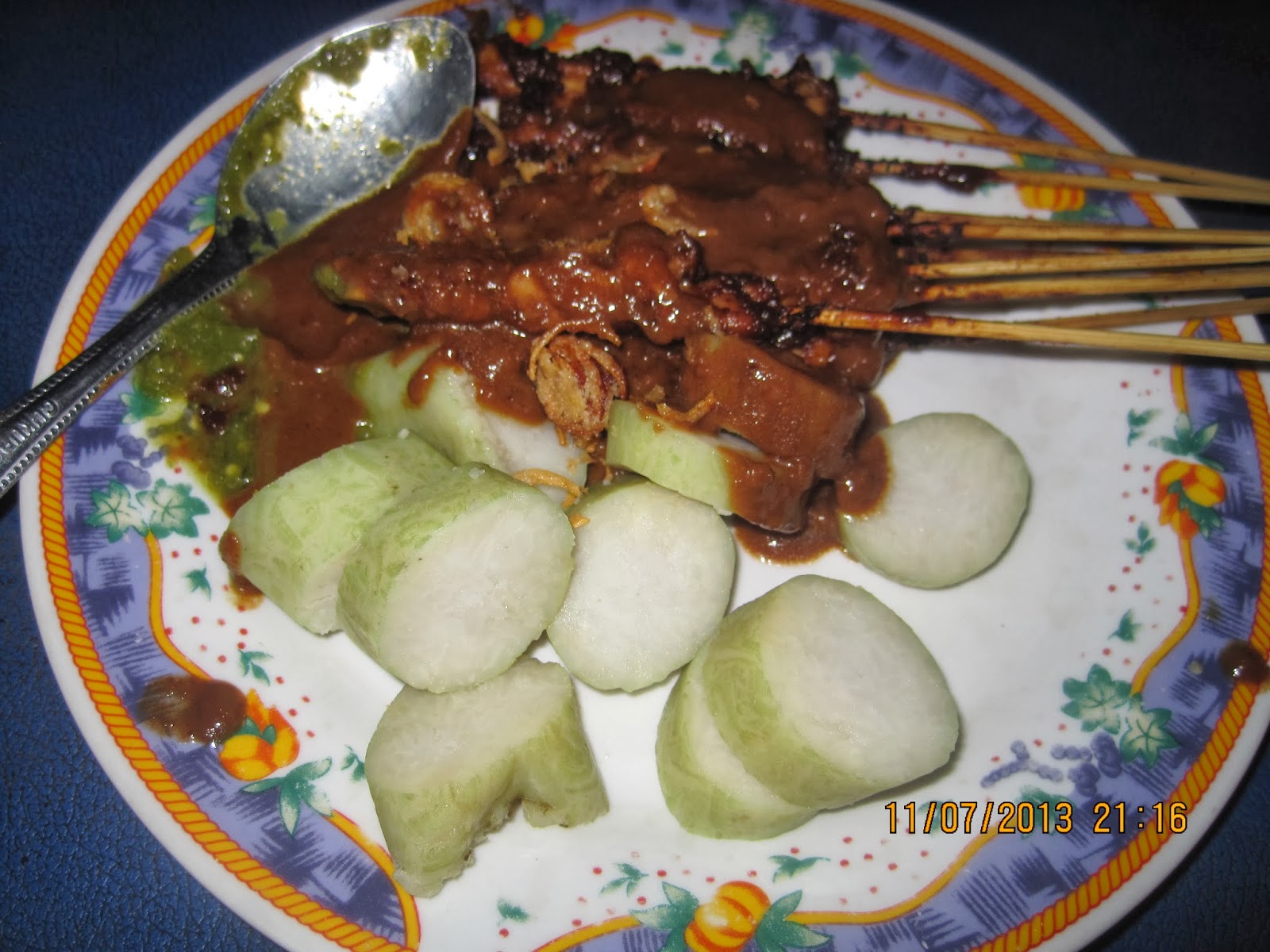
My delicious meal, Sate Ayam (Chicken Sate),
with peanut sauce and rice.
\